

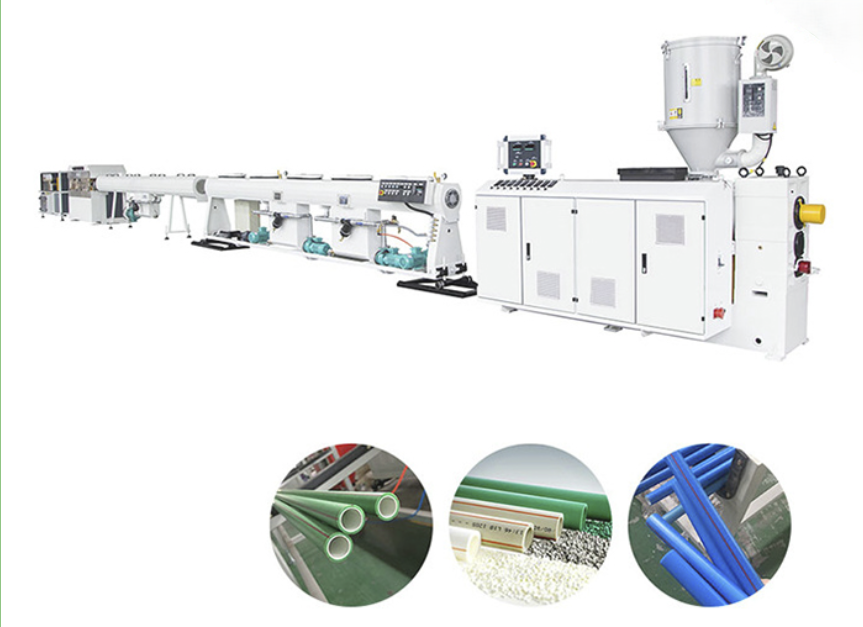
In the field of plastic pipe production, pipe extruders are indispensable core equipment. From the common household water pipes and decoration threading pipes in our daily lives, to the water supply and drainage pipes in municipal engineering and the optical cable protection pipes in the communication industry, their production process is inseparable from the support of pipe extruders. For beginners who have just entered the pipe production industry, small business entrepreneurs, or practitioners who need to purchase equipment but lack relevant experience, facing the wide variety of pipe extruders with different parameters on the market, they often fall into the dilemma of “not knowing how to choose” and “worrying about wasting costs by buying the wrong one”.
As a beginner’s guide to pipe extruders, this article will completely avoid complex professional terms and obscure technical parameters, focus on the three core issues most concerned by beginners: “classification, application scenarios, and purchasing”, and use popular language and specific cases to help you sort out your ideas, quickly grasp the basic cognition of pipe extruders, avoid basic misunderstandings in purchasing and use, and get started easily.
I. Core Classifications of Pipe Extruders: Divided by 2 Key Dimensions, Easy to Understand for Beginners
There are many ways to classify pipe extruders, such as by the number of screws, by pipe material, by production capacity, etc. However, for beginners, it is not necessary to master all classification methods. It is enough to focus on the two most core dimensions: “number of screws” and “pipe material adaptation”. These two dimensions directly determine the application scenario and purchasing cost of the equipment, and are also the points that beginners are most likely to confuse.
(I) Classified by the Number of Screws: Single Screw vs Twin Screw, Core Differences at a Glance
The screw is the “core component” of the pipe extruder, equivalent to the “heart” of the equipment. The difference in the number of screws directly affects the extrusion efficiency, raw material adaptability and production stability of the equipment. Most pipe extruders on the market are either single-screw or twin-screw. There is no absolute “good or bad” between the two, only “adaptability”.
1. Single-Screw Pipe Extruder: The First Choice for Beginners, Cost-Effective King
Single-screw pipe extruders are the most common and widely used models on the market, and also the first choice for beginners and small enterprises. Its core characteristics are simple structure, convenient operation, affordable price, low maintenance cost, and low technical requirements for operators, which is very suitable for beginners who have just started.
In terms of structure, a single-screw extruder has only one screw, mainly composed of a hopper, barrel, screw, die head, cooling system, traction and cutting system. The process is simple and easy to understand: pour plastic raw materials into the hopper, the raw materials are heated and melted through the barrel, pushed to the die head by the screw, extruded into a tubular shape, and then cooled and shaped, traction and cut to form the final finished pipe.
Its application scenarios are also very wide, mainly used for producing ordinary plastic pipes, such as PVC drainage pipes, PVC threading pipes, PE water supply pipes (ordinary pressure), PPR water supply pipes, etc. These are the most commonly used pipes in daily life and small projects, with large demand and relatively simple production process. Single-screw pipe extruders can fully meet the production needs.
For example: If you are a newly established small pipe processing factory, mainly producing household PVC threading pipes and ordinary PE water pipes, with a daily output demand of 500-1000 meters and a limited budget (50,000-200,000 yuan), then the single-screw pipe extruder is the best choice. It can not only meet the production needs, but also reduce the initial investment and maintenance cost, avoiding capital waste.
2. Twin-Screw Pipe Extruder: High-End Demand, High Efficiency and Stability
Twin-screw pipe extruders have two intermeshing screws, with a relatively complex structure, slightly higher operation difficulty than single-screw, relatively higher price, and higher maintenance cost. They are more suitable for enterprises with certain production experience, higher requirements for product quality and production efficiency, or scenarios for producing high-end and special pipes.
Compared with single-screw, the core advantages of twin-screw extruders are “high mixing uniformity, high extrusion efficiency and strong adaptability”. Due to the intermeshing of the two screws, the shearing and mixing effect of raw materials in the barrel is better, which can handle some raw materials with special properties, such as modified plastics and composite raw materials (such as glass fiber reinforced plastics). The produced pipes have more stable quality, more uniform wall thickness, smoother surface, and are not easy to have defects such as bubbles and scratches.
Its application scenarios are mainly high-end pipe production, such as high-pressure PE gas pipes, high-pressure water supply and drainage pipes, corrosion-resistant chemical pipes, composite pipes (such as aluminum-plastic composite pipes), etc. These pipes have high requirements for raw material mixing degree and extrusion stability, which single-screw pipe extruders are difficult to meet, so twin-screw pipe extruders must be used.
Note for beginners: If there is no demand for high-end pipe production in the early stage, and only ordinary plastic pipes are produced, it is not recommended to blindly purchase twin-screw pipe extruders. It will not only increase the initial investment, but also increase the operation and maintenance costs, resulting in resource waste. Only when the business expands to high-end pipe production or the daily output demand is extremely large (more than 2000 meters), then consider the twin-screw pipe extruder.
(II) Classified by Pipe Material Adaptation: Targeted Selection, Avoid the Misunderstanding of “One Machine for Multiple Uses”
Different materials of plastic pipes have great differences in production process and raw material characteristics, and the corresponding extruders also have certain pertinence. Although some extruders can adapt to multiple materials by adjusting the process, for beginners, “targeted selection” is more reliable, which can avoid problems such as unqualified pipe quality and low production efficiency caused by mismatching between equipment and materials. The mainstream pipe materials on the market are PVC, PE and PPR, and the corresponding extruders also have their own characteristics.
1. PVC Pipe Extruder: Adapt to PVC Material, Focus on Environmental Protection and Stability
PVC (polyvinyl chloride) is one of the most widely used plastic materials at present, and the demand for corresponding PVC pipes (drainage pipes, threading pipes, water supply pipes) is extremely large. PVC pipe extruders are also the models most commonly contacted by beginners. Since PVC raw materials are easy to produce harmful gases during heating, PVC pipe extruders are usually equipped with special exhaust devices to ensure that the production process meets environmental protection standards, and at the same time pay attention to temperature control accuracy to avoid raw material decomposition and affect pipe quality.
Most PVC pipe extruders are single-screw models, with relatively low price and simple operation, suitable for beginners to produce ordinary PVC pipes, and also the “entry-level model” for small pipe processing factories. It should be noted that PVC pipe extruders are not suitable for producing pipes of other materials such as PE and PPR. Forced adaptation will lead to uneven melting of raw materials and poor pipe forming effect.
2. PE Pipe Extruder: Adapt to PE Material, Focus on Pressure Resistance and Toughness
PE (polyethylene) material has the characteristics of corrosion resistance, low temperature resistance and good toughness, mainly used for producing water supply pipes, gas pipes, drainage pipes (large diameter), etc. Especially high-pressure gas pipes and water supply pipes have extremely high requirements for the pressure resistance and toughness of the pipes. Therefore, PE pipe extruders focus on screw design and temperature control system to ensure that the raw materials are fully melted, and the extruded pipes have uniform wall thickness and qualified toughness.
There are two types of PE pipe extruders: single-screw and twin-screw. For ordinary pressure PE water supply pipes and drainage pipes, single-screw extruders can meet the needs; for high-pressure PE gas pipes and large-diameter PE drainage pipes, twin-screw extruders are needed to ensure production stability and product quality.
3. PPR Pipe Extruder: Adapt to PPR Material, Focus on High Temperature Resistance and Weldability
PPR (random copolymer polypropylene) material has the characteristics of high temperature resistance, non-toxicity and corrosion resistance, mainly used for producing household water supply pipes, floor heating pipes, etc. This kind of pipe needs to bear a certain water temperature (usually not exceeding 70℃) and needs to be connected by welding. Therefore, PPR pipe extruders have higher requirements for temperature control accuracy and extrusion stability to ensure that the produced pipes have uniform molecular weight distribution, good welding performance and are not easy to have welding water leakage problems.
Most PPR pipe extruders are single-screw models, but the material of their screws and barrels is more wear-resistant and high-temperature resistant, and the temperature control system is more accurate. The price is slightly higher than that of ordinary PVC single-screw extruders, which is suitable for beginners and small enterprises specializing in the production of household PPR water supply pipes and floor heating pipes.
II. Application Scenarios of Pipe Extruders: Match on Demand, Do Not Blindly Pursue “High-End”
For beginners, the core principle of choosing a pipe extruder is “matching on demand” – according to their own production needs, product types and budget, choose the most suitable model, rather than blindly pursuing “high-end and high-power”. Combined with the above classification, here we sort out the model selection suggestions for beginners in different scenarios to help you quickly match and avoid stepping on pits.
(I) Beginners, Small Enterprises (Budget: 50,000-200,000 Yuan)
Core Needs: Produce ordinary plastic pipes, daily output 500-1000 meters, simple operation, low maintenance cost, less initial investment.
Suitable Models: Single-screw pipe extruders (prefer PVC or PE single-screw models).
Specific Scenarios and Selections:
1. Mainly produce household PVC threading pipes and PVC drainage pipes: Choose PVC single-screw extruders, price 50,000-100,000 yuan, simple operation and stable output, which can fully meet the production needs of household pipes, and is also the most reliable choice for beginners.
2. Mainly produce ordinary PE water supply pipes (low pressure) and PE drainage pipes: Choose PE single-screw extruders, price 80,000-150,000 yuan, good corrosion resistance, adapt to the melting characteristics of PE raw materials, the produced pipes have qualified toughness, suitable for residential and rural household water supply scenarios.
3. Mainly produce household PPR water supply pipes and floor heating pipes: Choose PPR single-screw extruders, price 100,000-200,000 yuan, high temperature control accuracy, ensure that the pipes are high temperature resistant and have good welding performance, suitable for decoration and household water supply scenarios.
(II) Enterprises with Certain Experience, Medium-Sized Enterprises (Budget: 200,000-500,000 Yuan)
Core Needs: Expand production scale, daily output 1000-2000 meters, partially involve high-end pipe production, have certain requirements for product quality and production efficiency.
Suitable Models: High-end single-screw models or entry-level twin-screw models.
Specific Scenarios and Selections:
1. Produce high-pressure PE water supply pipes and large-diameter PE drainage pipes: Choose twin-screw PE extruders, price 200,000-400,000 yuan, high extrusion efficiency, uniform raw material mixing, ensure that the pipes have pressure resistance and uniform wall thickness, suitable for municipal and residential large-scale water supply and drainage projects.
2. Produce multiple types of ordinary pipes (PVC, PE, PPR) at the same time: Choose high-end single-screw models with adjustable processes, price 150,000-300,000 yuan, equipped with precise temperature control system and replaceable die head, which can adapt to raw materials of different materials by adjusting processes, reduce equipment investment, and is suitable for diversified production.
(III) High-End Production, Large-Scale Enterprises (Budget: More Than 500,000 Yuan)
Core Needs: Produce high-end and special pipes, daily output more than 2000 meters, have extremely high requirements for product quality, production efficiency and stability, involve large-scale projects such as municipal, chemical and communication.
Suitable Models: High-end twin-screw models or customized models.
Specific Scenarios and Selections:
1. Produce high-pressure PE gas pipes and corrosion-resistant chemical pipes: Choose high-end twin-screw extruders, price 500,000-1,000,000 yuan, equipped with advanced temperature control system, exhaust system and intelligent monitoring system, ensure that the pipes have no bubbles and scratches, and the pressure resistance and corrosion resistance meet the standards, suitable for municipal gas and chemical transportation projects.
2. Produce composite pipes and special pipes (such as communication optical cable protection pipes, high-temperature resistant pipes): Choose customized twin-screw extruders, price more than 1,000,000 yuan, which can customize screws, die heads and processes according to the production needs of special pipes, adapt to special raw materials, and meet high-end engineering needs.
III. Basic Purchasing of Pipe Extruders: Must-See for Beginners, Pit-Avoiding Guide + Core Points
For beginners, when purchasing pipe extruders, they are most likely to fall into two misunderstandings: one is “the more expensive the better”, blindly pursuing high-end models, resulting in capital waste; the other is “the cheaper the better”, only looking at the price, ignoring equipment quality and after-sales service, leading to frequent failures in later production, affecting production progress, and even increasing costs.
Combined with the needs of beginners, here we sort out the “core purchasing points” and “pit-avoiding guide” to help you purchase accurately, and buy the most suitable equipment with the most appropriate budget.
(I) Core Purchasing Points: 3 Keys, Indispensable
1. Clarify your own production needs: This is the premise of purchasing. Before purchasing, beginners must first figure out “what kind of pipes they want to produce”, “what is the daily output” and “what is the budget”. These three questions directly determine the choice of model. For example, if you only produce PVC threading pipes with a budget of less than 100,000 yuan, there is no need to consider twin-screw models; if you want to produce high-pressure PE gas pipes, you must choose high-end twin-screw models, and cannot buy single-screw models greedily for cheap.
At the same time, it is also necessary to consider the size of the production site. For example, for small processing factories with limited space, choose single-screw models with compact structure and small floor area; for large workshops, choose twin-screw models or production lines with larger floor area according to production needs.
2. Pay attention to the core configuration of the equipment: For single-screw extruders, the core configuration is “screw, barrel, temperature control system”; for twin-screw extruders, it is also necessary to pay attention to “screw meshing accuracy and exhaust system”. These configurations directly determine the stability of the equipment and the quality of the produced pipes. Beginners do not need to pay attention to overly complex parameters, but focus on the following 3 points:
(1) Screw and barrel material: Priority is given to wear-resistant and high-temperature resistant materials (such as 38CrMoAlA). This kind of material has a long service life and is not easy to wear, which can avoid problems such as unstable extrusion and uneven pipe wall thickness caused by screw wear, and reduce later maintenance costs.
(2) Temperature control system: Must choose models with high temperature control accuracy (error ≤ ±1℃). Temperature control accuracy directly affects the melting effect of raw materials. Inaccurate temperature control is likely to lead to raw material decomposition, bubbles, scratches and other defects on the pipe surface, especially when producing PPR and PE pipes, the requirements for temperature control accuracy are higher.
(3) Cooling system: The cooling system should be efficient and uniform, which can quickly cool and shape the extruded pipes, avoid pipe deformation, and ensure accurate pipe dimensions. Especially when producing large-diameter pipes, the effect of the cooling system is crucial.
3. Attach importance to after-sales service: For beginners, after-sales service is more important than equipment price. Because beginners lack operation and maintenance experience, equipment will inevitably have failures during use. If after-sales service is not in place, it will lead to production shutdown and economic losses.
When purchasing, we must choose manufacturers with perfect after-sales service, focusing on 3 points: first, whether the manufacturer has a professional after-sales team and can provide on-site installation and commissioning services; second, whether the manufacturer can provide operation training to help beginners quickly master equipment operation skills; third, the after-sales response speed of the manufacturer, whether it can timely provide on-site maintenance when equipment fails, avoiding long-term shutdown.
(II) Beginner’s Purchasing Pit-Avoiding Guide: 4 Taboos, Do Not Step On
1. Taboo 1: Blindly pursue “high-power and high-end models”. Beginners have simple production needs in the early stage. High-end models are not only expensive, but also difficult to operate and have high maintenance costs, and many functions are not used, resulting in capital and resource waste. For example, if you only produce ordinary PVC threading pipes, but buy a high-end twin-screw model, it will not only increase the initial investment, but also increase the later electricity and maintenance costs.
2. Taboo 2: Only look at the price and ignore the equipment quality. Some manufacturers will reduce the equipment price to attract customers, but they will cut corners on core configurations, such as using inferior screws and barrels, and low-precision temperature control systems. Although such equipment is cheap, it has a short service life, is prone to failures, and has extremely high later maintenance costs, which is not worth the loss. When purchasing, beginners should adhere to “cost performance first” rather than “price first”.
3. Taboo 3: Ignore equipment adaptability and pursue “one machine for multiple uses”. Some beginners hope that one machine can produce pipes of multiple materials and specifications. Although some high-end models can achieve this, for beginners, “one machine for multiple uses” requires proficient mastery of process adjustment skills, and it is easy to lead to unqualified pipe quality. It is recommended that beginners use “specialized models”, first focus on producing one type of pipe, and consider diversified production after proficiently mastering the operation skills.
4. Taboo 4: Purchase blindly without understanding the manufacturer’s strength. Some small manufacturers do not have professional production technology and after-sales teams, and the quality of the produced equipment is not guaranteed, and the after-sales service is not in place. When purchasing, beginners must first understand the manufacturer’s strength, such as the manufacturer’s production scale, establishment time, customer evaluation, etc., and prefer manufacturers with a long establishment time, good customer evaluation and a certain production scale to avoid purchasing inferior equipment.
IV. Supplementary for Beginners: Key Points of New Machine Commissioning and Daily Simple Maintenance
For beginners, after buying a suitable equipment, the commissioning of the new machine and daily maintenance are also very important. Correct commissioning and maintenance can extend the service life of the equipment, avoid equipment failures, and ensure stable production. Here we supplement several key points of new machine commissioning and daily simple maintenance that beginners can quickly master, which are simple and easy to understand without professional technology.
(I) Key Points of New Machine Commissioning
1. After the new machine is installed, do not rush to feed and produce. First, conduct no-load test run for 1-2 hours to check the operation of the equipment, such as whether the screw speed is stable, whether the temperature control system is normal, whether the cooling system is unblocked, and whether there is abnormal noise or failure.
2. After the no-load test run is normal, carry out feeding commissioning. The initial feeding amount should be small and gradually increased. At the same time, adjust the screw speed, temperature control temperature and traction speed, observe the forming effect of the pipe, and enter normal production only after producing pipes with accurate dimensions, smooth surface and no defects.
3. During the commissioning process, if problems such as uneven pipe wall thickness, bubbles and scratches on the surface occur, first check whether the temperature control temperature is appropriate and whether the screw speed is stable, then adjust the die head and traction system, and do not disassemble the equipment blindly.
(II) Key Points of Daily Simple Maintenance
1. Daily maintenance: After production, timely clean the remaining raw materials in the hopper, screw and die head to avoid raw material caking and affecting the next production; check the water level of the cooling system and supplement cooling water in time; check the connection parts of the equipment and tighten them in time if they are loose.
2. Weekly maintenance: Check the wear of the screw and barrel, and apply lubricating oil in time if there is slight wear; check the sensor of the temperature control system to ensure temperature control accuracy; clean the filter of the cooling system to avoid blockage.
3. Monthly maintenance: Lubricate the transmission system and traction system of the equipment to extend the service life of the components; check the electrical system of the equipment to ensure that the lines are unblocked without aging or damage; fully clean the equipment to avoid dust accumulation and affect the operation of the equipment.
V. Summary
For beginners, getting started with pipe extruders is not complicated. The core is to master the three core points of “classification, application scenarios and purchasing”, adhere to the principle of “matching on demand and cost performance first”, avoid basic misunderstandings in purchasing and use, and get started easily.
Single-screw extruders are suitable for beginners and small enterprises, with simple operation and affordable price, which can meet the production needs of ordinary plastic pipes; twin-screw extruders are suitable for high-end and large-scale production, with high efficiency and stable quality, but high price and maintenance cost. When purchasing, we must clarify our own production needs, pay attention to the core configuration and after-sales service of the equipment, not blindly pursue high-end, nor be greedy for cheap; in the process of use, do a good job in new machine commissioning and daily maintenance, so as to ensure the stable operation of the equipment and produce qualified pipes.
With the accumulation of production experience, beginners can gradually learn more technical knowledge about pipe extruders, adjust equipment and production processes according to business expansion needs, and gradually expand production scale. It is hoped that this beginner’s guide can help more beginners quickly enter the pipe production industry, avoid pits, take fewer detours, and achieve steady development.
If you have any questions regarding the selection or production volume, please feel free to contact me!
Tel/WhatsApp: +86 156 9521 7551
Email: olive@wanplas.com