

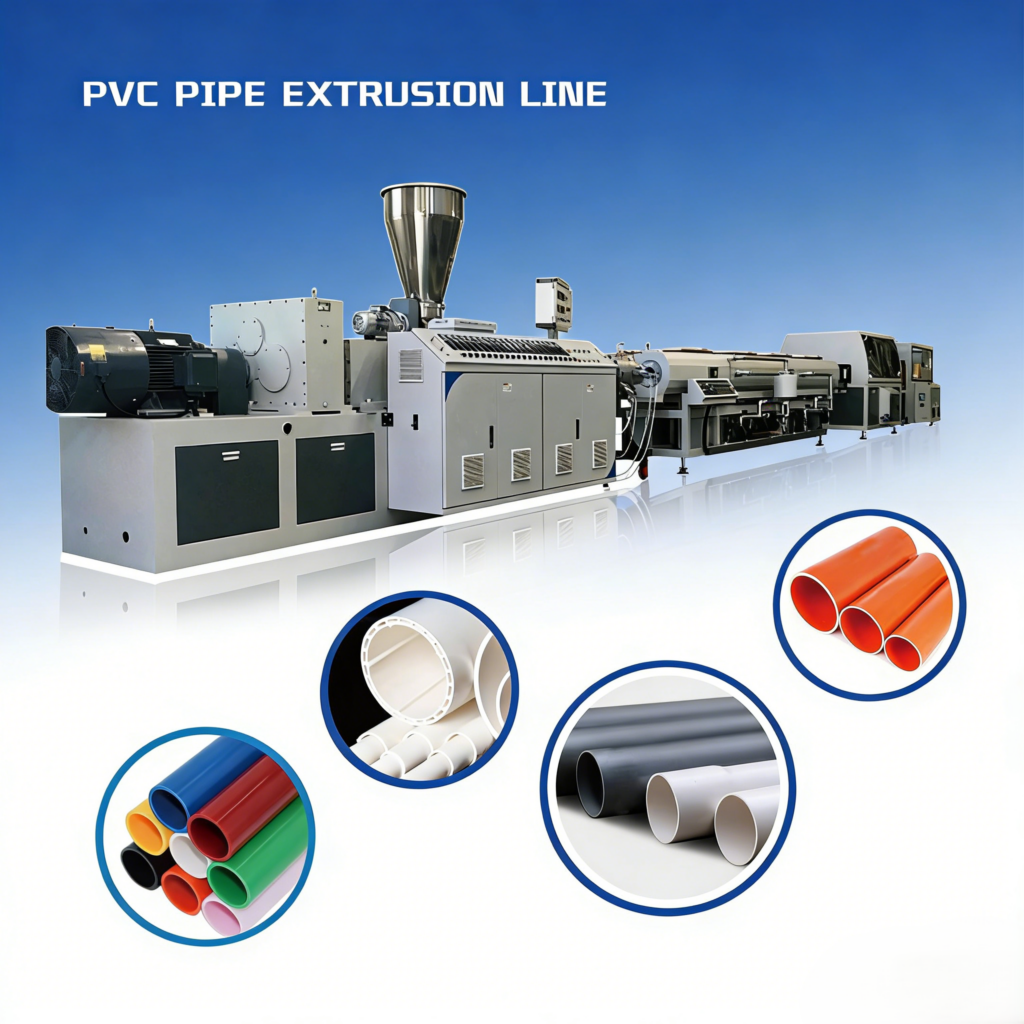
In today’s competitive plastic piping market, product quality and production stability define long-term success. PVC pipes remain essential in municipal drainage, building water supply systems, electrical conduits, irrigation networks, and infrastructure projects worldwide.
However, consistent pipe quality does not happen by chance. It depends on a precisely engineered PVC pipe extrusion line that integrates reliable plasticizing performance, accurate dimensional control, energy efficiency, and intelligent automation.
This article provides a comprehensive and technically accurate overview of PVC pipe extrusion systems, covering equipment configuration, processing principles, quality control factors, energy-saving technologies, and investment considerations.
1. Complete Configuration of a PVC Pipe Extrusion Line
A standard PVC pipe extrusion line typically consists of:
- Automatic feeding and mixing system
- Conical Twin Screw Extruder
- Pipe extrusion die head and calibrator
- Vacuum calibration tank
- Spray cooling tank
- Haul-off (puller) unit
- Cutting unit
- Socketing machine (optional)
- Automatic stacking system
Each component must be precisely matched to ensure stable output, dimensional accuracy, and consistent surface quality.
2. Why PVC Requires a Conical Twin Screw Extruder
PVC (polyvinyl chloride) is a heat-sensitive thermoplastic with a relatively narrow processing window. Excessive temperature or shear stress can lead to material degradation, discoloration, and mechanical property loss.
The Conical Twin Screw Extruder is widely used in PVC pipe production because it provides:
2.1 Superior Plasticizing Performance
- Strong mixing and homogenization
- Stable melt temperature
- Uniform material distribution
- Smooth internal and external pipe surfaces
2.2 Controlled Shear and Temperature
The conical screw geometry ensures gradual compression and controlled shear rate, reducing the risk of PVC degradation while maintaining adequate melt strength.
2.3 High Torque and Stable Output
Modern gearboxes with high torque reserves allow continuous production with minimal fluctuation, even when processing high-filler formulations.
3. Extrusion Die System: Determining Pipe Quality
The die head is one of the most critical components in the entire line. It directly influences:
- Wall thickness uniformity
- Pipe roundness
- Surface smoothness
- Mechanical strength
A high-quality die system typically features:
- Balanced spiral flow channels
- Optimized mandrel design
- Chrome-plated or nitrided surfaces
- Efficient internal heating control
Proper melt flow distribution inside the die prevents weld lines, uneven thickness, and internal stress concentration.
4. Vacuum Calibration and Cooling System
After exiting the die, the pipe remains in a semi-molten state and must be calibrated immediately to maintain dimensional precision.
4.1 Vacuum Calibration Tank
Key characteristics include:
- Multi-stage vacuum control
- Independent water circulation system
- Automatic water level regulation
- Stainless steel construction
Stable negative pressure ensures precise outer diameter control and prevents ovality.
4.2 Spray Cooling Tank
Gradual and uniform cooling minimizes internal stress and deformation. Adequate cooling length is particularly important for large-diameter or thick-wall pipes.
5. Haul-Off and Cutting Units
5.1 Haul-Off System
The haul-off speed must be perfectly synchronized with extrusion output. Advanced systems feature:
- Multi-track belt design
- Individual motor control
- Frequency inverter synchronization
- Adjustable clamping force
Improper traction can cause wall thickness variation or surface indentation.
5.2 Cutting System
Depending on pipe diameter and wall thickness, cutting options include:
- Planetary cutting
- Chipless cutting
- Automatic length control
High-end systems integrate automatic chamfering and dust extraction.
6. Process Stability and Quality Control Factors
Several critical factors determine the final pipe quality:
6.1 Temperature Control Accuracy
PVC processing typically requires multi-zone temperature control. Precision PID controllers maintain temperature deviation within tight tolerances, preventing degradation.
6.2 Screw Design and Compression Ratio
Proper screw configuration ensures:
- Efficient melting
- Controlled shear
- Stable output pressure
6.3 Vacuum Stability
Fluctuating vacuum pressure directly affects pipe diameter consistency.
6.4 Automation and Monitoring
Modern extrusion lines include:
- PLC centralized control
- Touchscreen HMI interface
- Real-time production data monitoring
- Alarm and fault diagnosis systems
- Remote technical support capability
These features reduce human error and improve operational reliability.
7. Energy Efficiency and Cost Reduction
Energy consumption is a significant part of production cost. Advanced PVC pipe extrusion lines incorporate:
- High-efficiency permanent magnet motors
- Variable frequency drives (VFD)
- Electromagnetic heating systems
- Optimized cooling water circulation
Compared to conventional systems, energy consumption can be reduced by 15–30%, depending on configuration and production conditions.
Over long-term operation, energy savings significantly enhance return on investment.
8. Production Capacity and Flexibility
PVC pipe extrusion lines can be configured for various pipe standards and diameters, such as:
- Electrical conduits
- Water supply pipes
- Drainage pipes
- Pressure pipes
With proper screw and die configuration, the same line can accommodate multiple diameters through quick die changes and calibration adjustments.
High-speed lines combined with optimized cooling systems enable increased output without compromising quality.
9. Return on Investment Considerations
When evaluating a PVC pipe extrusion project, consider:
- Target pipe diameter range
- Required daily output
- Local energy cost
- Labor cost
- Market demand stability
A well-configured medium-capacity PVC pipe extrusion line typically achieves capital recovery within 6–12 months under stable market conditions.
Higher automation reduces labor dependence and downtime, further improving profitability.
10. Future Development Trends
The PVC pipe industry is moving toward:
- Higher output efficiency
- Intelligent manufacturing integration
- Real-time data analysis
- Online measurement and quality inspection
- Fully automated packaging systems
Smart extrusion systems will enable predictive maintenance, process optimization, and improved traceability.
Conclusion
A PVC pipe extrusion line is not merely a combination of mechanical components—it is a complete engineering system that determines product quality, operational stability, and long-term profitability.
Selecting the right configuration ensures:
- Consistent output
- Reduced scrap rate
- Lower energy consumption
- Improved dimensional accuracy
- Sustainable competitive advantage
For manufacturers planning to enter or upgrade PVC pipe production, careful equipment selection and technical matching are critical to maximizing operational efficiency and return on investment. If you are interested, please feel free to contact us at any time!
WhatsApp: +86-156-9521-7551
Email: olive@wanplas.com