

HDPE (High-Density Polyethylene) pipes are widely used in water supply and drainage, petrochemical, gas transmission, agricultural irrigation and other fields due to their excellent corrosion resistance, wear resistance, impact resistance and environmental friendliness and recyclability. As the core equipment for HDPE pipe production, the classification of HDPE Pipe Extrusion Lines needs to be considered from multiple dimensions such as production scale, technical level, product characteristics and application scenarios. Based on mainstream classification dimensions, this article will detailedly analyze the core characteristics, technical parameters and application scope of various production lines to provide reference for industry selection.
I. Classification by Type of Pipes Produced
This classification dimension is based on the core output of the production line and is the most basic classification method in the industry. Different types of production lines have significant differences in equipment structure and molding process to adapt to the performance requirements of different pipes.
1. Solid-Wall HDPE Pipe Extrusion Line
The solid-wall HDPE pipe extrusion line is the most widely used basic type, mainly producing HDPE pipes with a solid circular cross-section, suitable for urban water supply, gas transmission, industrial fluid transmission and other scenarios. Its core feature is a single-screw extrusion host matched with a vacuum shaping and cooling system to ensure the dimensional accuracy and surface smoothness of the pipes.
In terms of core parameters, this type of production line can cover a product range with pipe diameters from 16mm to 2000mm. The production capacity varies greatly according to the model: the production capacity of ordinary models is 100-500kg/h, and that of high-speed models can reach 1000-3000kg/h. In terms of price, affected by the pipe diameter range, production capacity and automated configuration, the reference price of ordinary models is about 150,000-800,000 RMB/set, and the price range of high-speed intelligent models is 800,000-2.5 million RMB/set. For example, Benk Machinery’s KPM series high-speed solid-wall production line is designed for pipes with diameters of φ20-φ1200mm, with a maximum production capacity of 1700kg/h. It adopts PLC intelligent modular control to realize automated production and real-time data monitoring, with a market reference price of about 1.2-1.8 million RMB/set. The key technology of this type of production line lies in the special design of the screw and barrel, which usually adopts a length-diameter ratio of 33:1 or 38:1 to ensure the full plasticization of HDPE raw materials. At the same time, it is equipped with a precision vacuum shaping box and a multi-track tractor to ensure the uniformity of pipe wall thickness (the error can be controlled within ±0.05mm).
2. HDPE Double-Wall Corrugated Pipe Extrusion Line
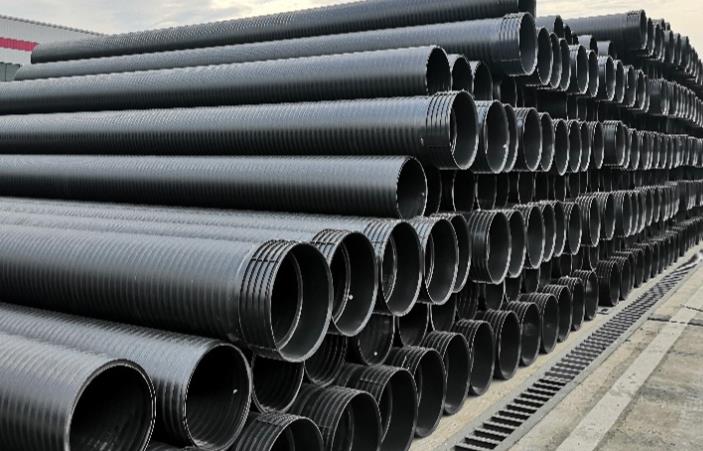
Designed specifically for the production of HDPE double-wall corrugated pipes, this type of pipe has a smooth inner wall and a corrugated outer wall, featuring light weight, high strength and strong external pressure resistance. It is mainly used in municipal drainage, sewage discharge and agricultural irrigation fields. The production line adopts an integrated process of “extrusion-vacuum molding-cooling shaping”, and the core equipment includes a host extruder, a corrugated molding machine, a vacuum system and a cutting device.
According to the molding method, it can be divided into vertical and horizontal structures. Vertical models are suitable for small and medium-diameter pipes (inner diameter 200-800mm), while horizontal models can produce large-diameter pipes. In terms of price, the reference price of small and medium-diameter vertical models is about 250,000-1.2 million RMB/set. Due to the increased equipment tonnage and molding difficulty, the price range of large-diameter horizontal models is 1.2-3 million RMB/set. For example, Shanghai Jinwei’s DWC-2000 series can produce double-wall corrugated pipes with an inner diameter of 200-800mm, equipped with a high-efficiency single-screw extruder and a computer control system, with a production capacity of 700-1400kg/h. The maximum ring stiffness of the pipe can reach SN32 level, meeting the needs of complex buried environments, with a market reference price of about 800,000-1.5 million RMB/set. The core advantage of this type of production line is the adoption of vacuum molding technology, which makes the corrugated structure fit closely. At the same time, it is equipped with an online wall thickness detection system to ensure the uniformity of inner and outer wall thickness and improve the service life of the pipe.
3. Reinforced HDPE Pipe Extrusion Line
Aimed at special application scenarios such as high pressure and heavy load, the reinforced HDPE pipe extrusion line improves the pressure resistance and ring stiffness of pipes through composite reinforced materials or special structural design, mainly including steel strip reinforced, steel wire wound reinforced and other types.
The steel strip reinforced HDPE spiral corrugated pipe extrusion line is a typical representative, which adopts the “steel-plastic composite” process and forms through steel strip winding and HDPE melt compounding. It is suitable for large-diameter municipal drainage and sewage pipes (pipe diameter 300-4500mm). The price of this type of production line is greatly affected by the upper limit of pipe diameter and the configuration of steel strip processing equipment, with a reference price of 800,000-8 million RMB/set; the steel wire wound reinforced production line has a higher price due to high-pressure molding and anti-corrosion treatment, with a range of 1.5-12 million RMB/set. Jinshi Dongfang’s SRPE series production line can produce steel strip reinforced pipes with D300-D3000mm, and the ring stiffness can reach above S10. Compared with all-plastic pipes, it can save more than 30% of material costs, and has excellent impact resistance and corrosion resistance, with a market reference price of about 2-5 million RMB/set. The steel wire wound reinforced production line is mainly used in high-pressure water supply and oil-gas transmission fields. It forms a reinforced layer through high-strength steel wire winding, and the working pressure of the pipe can be increased to more than 10MPa. For example, the RTP-250 series coiled hose production line can realize the installation of 1 kilometer of pipes in a single day, greatly improving construction efficiency, with a reference price of about 3-8 million RMB/set.
4. Multi-Layer HDPE Pipe Extrusion Line
It adopts multi-screw co-extrusion technology to produce HDPE pipes with multi-layer structures, usually 2-7 layers. Through the functional matching of materials in different layers (such as barrier layer, reinforced layer, anti-ultraviolet layer), it meets special use needs. For example, a 3-layer water supply pipe production line has a food-grade HDPE inner layer, an EVOH barrier layer in the middle, and an anti-ultraviolet outer layer, which can effectively prevent water pollution and pipe aging.
The core advantage of this type of production line is high material utilization rate, which can accurately control the thickness distribution of each layer. It is suitable for high-end fields such as drinking water transmission, gas transmission and chemical anti-corrosion. In terms of price, due to the high requirements for co-extrusion layers, precision control and raw material adaptability, the reference price of basic 2-3 layer models is about 600,000-2 million RMB/set, and the price range of high-precision 4-7 layer models is 2-5 million RMB/set. The TubeFlex series 7-layer production line can realize flexible combination of color, material and layer thickness, and adjust the layer distribution through adjustable rotating elements to meet the production needs of barrier film pipes with extremely high requirements for layer thickness precision, with a market reference price of about 3.5-6 million RMB/set. In terms of production capacity, the multi-layer production line is usually 300-1200kg/h, equipped with an integrated gravity metering system, which can monitor product quality in real time and reduce the rejection rate.
II. Classification by Production Scale
Based on the production capacity and applicable pipe diameter range, HDPE Pipe Extrusion Lines can be divided into small, medium and large types, corresponding to the needs of enterprises and projects of different scales respectively.
| Type | Applicable Pipe Diameter | Production Capacity Range | Price Range (Reference Price) | Core Features | Application Scenarios |
| Small-Scale Production Line | 16-160mm | 100-300kg/h | 150,000-500,000 RMB/set | Small floor space, low investment cost, simple operation, mainly semi-automatic control | Small enterprises, family workshops, small-diameter pipe production for agricultural irrigation |
| Medium-Scale Production Line | 75-630mm | 300-1000kg/h | 500,000-2,000,000 RMB/set | Medium degree of automation, equipped with PLC control system, stable production capacity, suitable for various raw materials | Small and medium-sized municipal projects, regional water supply/drainage projects, small and medium-sized manufacturing enterprises |
| Large-Scale Production Line | 315-4500mm | Above 1000kg/h | 2,000,000-10,000,000+ RMB/set | Full automatic control, equipped with online detection and intelligent monitoring system, high technical requirements | Large municipal key projects, petrochemical projects, large-scale pipe production enterprises |
For example, Sharc Machine’s PE63 small-scale production line is suitable for pipes with 16-63mm, with a production capacity of 150-300kg/h and a motor power of 45-75kw, which is suitable for small enterprises to start; while its PE2000 large-scale production line is suitable for pipes with 800-2000mm, with a production capacity of 2400-3000kg/h, which needs to be equipped with a twin-screw extruder and a special tractor.
III. Classification by Technical Level
With the development of automation and intelligent technology, production lines can be divided into traditional production lines and intelligent production lines according to technical level. There are significant differences between the two in control methods, production efficiency and product quality.
1. Traditional Production Line
Mainly relying on manual operation, with a low degree of automation, it mainly relies on the experience of operators to control the production process. The core equipment includes a single-screw extruder, a simple shaping box and a manual traction and cutting device. The price is relatively low, with a reference price of about 100,000-800,000 RMB/set, which fluctuates slightly according to the pipe diameter and production capacity. Its advantages are low equipment cost and simple maintenance, suitable for small-diameter pipe production with low technical requirements; but it has disadvantages such as low production efficiency (more than 30% lower than intelligent production lines), poor product quality stability and high labor cost.
Traditional production lines still exist in some small enterprises and developing country markets. With the tightening of environmental regulations and the intensification of market competition, they are gradually replaced by intelligent production lines.
2. Intelligent Production Line
It adopts advanced automatic control technology and intelligent monitoring system to realize the full-process automation from raw material feeding to finished product stacking. The core features include PLC centralized control, touch screen operation, real-time data recording, closed-loop feedback adjustment and online quality inspection.
Intelligent production lines can realize 24-hour uninterrupted production, with production efficiency more than 30% higher than traditional production lines, and the dimensional accuracy error of products can be controlled within ±0.03mm. The price varies greatly according to the degree of intelligence, production capacity and configuration. The reference price of basic intelligent models is about 500,000-2 million RMB/set, the price range of high-end intelligent models (including AI detection and big data monitoring) is 2-5 million RMB/set, and the price of some customized large-scale intelligent production lines can exceed 10 million RMB/set. For example, Benk Machinery’s production line adopts well-known brand electrical components such as Siemens and Schneider to realize automatic control, real-time data recording and closed-loop control. The products have passed CE and ISO certifications and have “European performance” standards, with a reference price of about 1.5-3.5 million RMB/set. Shanghai Jinwei’s FDC series intelligent production line adopts modular design, which can realize automatic size adjustment of pipes with diameters of 200-630mm, with simple operation, uniform pipe surface and accurate wall thickness distribution, with a reference price of about 800,000-2 million RMB/set.
In addition, intelligent production lines also have energy-saving advantages. By optimizing the screw design and drive system, the energy consumption is 15-20% lower than that of traditional production lines. At the same time, they are equipped with intelligent diagnosis functions, which can monitor the operation status of equipment in real time, predict faults in advance and reduce downtime losses. According to statistics, the global market share of intelligent HDPE pipe extrusion lines is increasing year by year, and it is expected to occupy a dominant position in the market by 2025.
IV. Core Selection Points and Development Trends
1. Core Selection Points
Enterprise selection needs to combine their own production capacity needs, product positioning and application scenarios: first, clarify the pipe type and specifications, such as double-wall corrugated pipe production lines are preferred for municipal drainage, and reinforced production lines are needed for high-pressure water supply; second, match the production scale, small enterprises can choose economical small-scale production lines, and large-scale projects need to be equipped with efficient and intelligent large-scale production lines; third, pay attention to technical parameters, focusing on production capacity, pipe diameter range, motor power and automation level; fourth, balance cost and benefit, and comprehensively evaluate equipment investment, operation and maintenance costs and investment payback period.
2. Development Trends
In the future, HDPE Pipe Extrusion Lines will show three major development directions: first, intelligent upgrading, introducing technologies such as AI visual inspection and big data analysis to further improve production efficiency and product quality; second, large-scale and precision, developing production lines with higher production capacity and precision for the needs of large-diameter and high-end pipes, narrowing the gap with international advanced levels; third, green and energy-saving, optimizing equipment structure and processes, reducing energy consumption and raw material loss, in line with the global trend of environmental protection. At the same time, with the growth of infrastructure construction demand in emerging markets, intelligent production lines suitable for small and medium-diameter pipes with high cost performance will become a hot spot in market growth.
Conclusion
The classification of HDPE Pipe Extrusion Lines presents multi-dimensional characteristics. According to the pipe type, it can be divided into solid-wall, double-wall corrugated, reinforced, multi-layer and other types; according to the production scale, it can be divided into small, medium and large types; according to the technical level, it can be divided into traditional and intelligent types. Different types of production lines have their own applicable scenarios, and enterprises need to make precise selection according to their own needs. With technological innovation and the upgrading of market demand, intelligent, efficient and green production lines will become the mainstream of the industry’s development, promoting the HDPE pipe industry to move towards higher quality and wider application fields.