

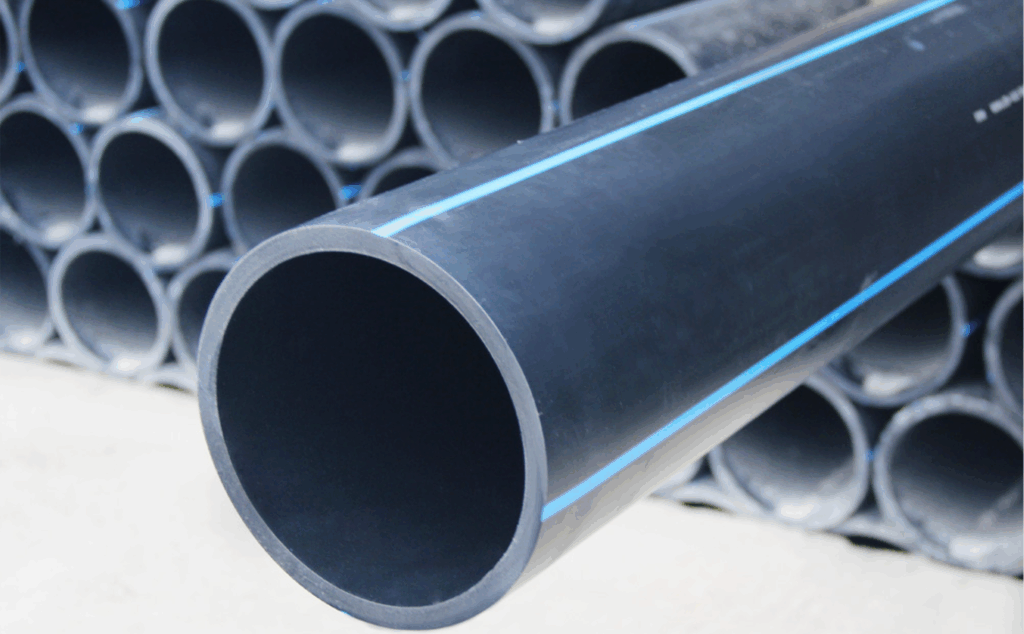
High-Density Polyethylene (HDPE) material is widely used in water supply and drainage, gas transmission, communication pipelines and other fields due to its excellent properties such as corrosion resistance, impact resistance, and environmental friendliness and recyclability. As the core production equipment for small and medium-caliber HDPE pipes, the 20-63 HDPE production line’s reasonable structural configuration is the foundation for ensuring pipe quality. Driven by industrial upgrading and policy guidance, this type of production line is ushering in a new stage of high-quality development. As a professional brand deeply engaged in the plastic machinery field, WANPLAS has launched the 20-63 HDPE production line, which has become an important promoter in the process of industrial upgrading with its precise technical positioning and comprehensive service guarantee.
I. Analysis of the Core Components of the 20-63 HDPE Production Line
The 20-63 HDPE production line is a full-process automated equipment integrating “raw material processing – melt extrusion – molding and cooling – traction and cutting – finished product stacking”. All components work together to ensure that the outer diameter of the produced HDPE pipes is accurately controllable within the range of 20-63mm, meeting the application needs of different scenarios. Combined with the mainstream industry configuration and WANPLAS’s technical design, its core components can be divided into seven key systems:
1. Automatic Feeding and Drying System
As the starting link of the production line, this system is mainly composed of an automatic feeder and a hopper dryer. The automatic feeder accurately conveys HDPE granular raw materials into the hopper through the negative pressure conveying principle, avoiding dust pollution and raw material waste caused by manual feeding; the hopper dryer realizes raw material drying through hot air circulation according to the moisture absorption characteristics of HDPE raw materials, removing moisture and impurities, and ensuring the stability of the subsequent melt extrusion process. WANPLAS adopts a closed conveying design in this system, which effectively reduces the risk of raw material pollution. At the same time, it is equipped with intelligent temperature control and material level monitoring functions to realize the automatic coordination of feeding and drying.
2. Core Extrusion System
The extrusion system is the “heart” of the production line, directly determining the melting quality and production efficiency of the pipes. The 20-63 HDPE production line usually adopts a single-screw extruder, with the mainstream configuration being the SJ65/33 model. Its screw and barrel are made of high-quality 38CrMoAl alloy material, which has excellent wear resistance and heat resistance after nitriding treatment. WANPLAS has made targeted optimizations to the extrusion system, adopting an efficient screw design, combined with a Siemens standard motor and an ABB inverter, to achieve precise speed regulation. The extrusion capacity can reach 100kg/h, which not only ensures full melting and plasticization of raw materials but also effectively reduces energy consumption. In addition, the system is also equipped with a self-lubricating hardened gearbox to improve operational stability and service life.
3. Precision Head and Mold System
The head and mold are key components for pipe molding, and their structural design directly affects the wall thickness uniformity and dimensional accuracy of the pipes. The 20-63 HDPE production line mostly adopts a basket-type head or a spiral split composite head. This type of head has the advantages of uniform material dispersion, small pressure loss, and convenient adjustment. Targeting the molding needs of 20-63mm small and medium-caliber pipes, WANPLAS has precisely processed the mold. Through a modular design, it can quickly switch between molds of different specifications to adapt to the production of various pipes within the range of 20-63mm. At the same time, the head is equipped with a temperature zoning control system to ensure stable temperature of the molten material during the molding process and further improve the pipe molding quality.
4. Vacuum Shaping and Cooling System
The pipe blank extruded from the head needs to be solidified and formed through a shaping and cooling system. This system is mainly composed of a vacuum shaping box and a spray cooling box. The vacuum shaping box adopts a double-chamber structure, and through precise vacuum degree control, the pipe blank is closely attached to the inner wall of the shaping sleeve to ensure the outer diameter accuracy of the pipe; the spray cooling box is made of 304 stainless steel, and realizes rapid and uniform cooling of the pipe through high-pressure spray, improving the mechanical properties of the pipe. WANPLAS has added an automatic water temperature control system to this system, which can real-time adjust the cooling water temperature according to the ambient temperature and production speed, avoiding pipe deformation caused by uneven cooling. At the same time, the coordinated control of the vacuum system and the cooling system ensures that the pipe shaping accuracy error is within ±0.15mm, which is better than the industry average.
5. Traction System
The core function of the traction system is to pull the cooled and solidified pipe to the subsequent cutting link at a stable speed. The stability of the traction speed directly affects the wall thickness uniformity of the pipe. The 20-63 HDPE production line generally adopts a three-jaw crawler tractor, which has the advantages of large traction force and stable clamping. WANPLAS’s traction system is equipped with a high-precision meter counter, which can real-time measure the pipe length. At the same time, through the PLC control system, it realizes precise synchronization between the traction speed and the extrusion speed, avoiding pipe stretching or accumulation, and ensuring production continuity.
6. Dust-Free Cutting and Stacking System
The cutting system adopts a PLC-controlled dust-free cutting machine, which can automatically and accurately cut the pipe according to the preset length. No dust is generated during the cutting process, which not only ensures a clean workshop environment but also avoids pollution of the pipe end face by cutting dust. The cut pipes are neatly stacked through a tilting frame or an automatic stacking machine, reducing manual handling costs. WANPLAS’s cutting system supports switching between multiple cutting methods to adapt to the needs of pipes with different wall thicknesses. At the same time, the stacking machine is equipped with a counting function to facilitate production statistics and finished product management.
7. Intelligent Control System
Modern 20-63 HDPE production lines are all equipped with intelligent control systems to realize full-process automatic control and monitoring. The system adopts Siemens PLC as the control core, combined with a color large-screen human-machine interface, which can real-time display production parameters (such as extrusion temperature, traction speed, vacuum degree, etc.), and has a complete alarm function. When parameters are abnormal, it can issue an early warning and shut down the machine in time to reduce the rejection rate. WANPLAS’s control system also supports parameter memory and call functions. For the production of pipes of different specifications, preset parameters can be quickly retrieved to improve the product change efficiency. At the same time, it has a remote monitoring function to facilitate enterprises to realize remote management and control of the production process.
II. Prospect of the 20-63 HDPE Production Line
Against the background of global green and low-carbon transformation and the continuous advancement of domestic infrastructure construction, the 20-63 HDPE production line, as the core production equipment for small and medium-caliber HDPE pipes, shows a clear positive trend in both market demand and technological upgrading direction, with broad development prospects.
1. Policy-Driven Broad Market Space
Domestically, the 14th Five-Year Plan clearly proposes to promote the renovation of urban underground pipe networks, rural drinking water safety projects and other infrastructure constructions. Small and medium-caliber HDPE pipes have become one of the core materials for these projects due to their strong adaptability. At the same time, the “Plastic Pollution Control Action Plan (2024-2027)” encourages the high-value utilization of recycled HDPE, which further activates the pipe production demand under the circular economy chain. Internationally, emerging markets such as Southeast Asia and the Middle East have seen continuous growth in import demand for HDPE pipes due to the acceleration of infrastructure construction, driving the export demand of 20-63 HDPE production lines. Data show that the export volume of China’s HDPE-related equipment in 2024 increased by nearly 172% compared with 2021, among which small and medium-caliber production lines have become the main export force due to their cost-performance advantage.
2. Technological Upgrading Leads High-Quality Industrial Development
In the future, the technological upgrading of the 20-63 HDPE production line will focus on three core directions: first, intelligent improvement. Through the introduction of AI quality inspection, digital twin and other technologies, it will realize full-parameter precise control of the production process and further improve the yield rate. At present, the yield rate of intelligent production lines of leading enterprises has been increased to more than 98.5%, and this technology will be gradually popularized in the whole industry in the future; second, green transformation. Through optimizing the design of the extrusion system and adopting green power drive, it will reduce the unit product energy consumption and carbon emissions. The current average comprehensive energy consumption per unit product in the industry is 0.45 tce/ton, while the international advanced level has dropped to below 0.31 tce/ton. Green energy saving has become one of the core competitiveness of enterprises; third, flexible production. Through modular design, it will improve the specification adaptability of the production line, realize rapid switching production of pipes of various calibers and uses, and meet the diversified market demand.
3. Improvement of Industrial Chain Coordination Enhances Industrial Competitiveness
With the transformation of the HDPE industry from “scale expansion” to “quality improvement”, enterprises of 20-63 HDPE production lines will pay more attention to cooperative cooperation with the upstream and downstream industrial chains. Upstream, it will jointly develop more adaptable HDPE special materials with raw material enterprises to improve production efficiency and pipe quality; downstream, it will provide customized production solutions for different application scenarios such as water supply and drainage, gas, and communication. At the same time, the industrial concentration will continue to increase. Enterprises with technical advantages and full industrial chain service capabilities will occupy more market share, and the CR10 market share is expected to further increase to more than 50%.
III. WANPLAS Brand: Empowering the High-Quality Development of 20-63 HDPE Production Lines
In the upgrading wave of 20-63 HDPE production lines, WANPLAS, relying on years of R&D and design experience in plastic machinery, has become a representative brand in the industry with its precise technical positioning, reliable product quality and comprehensive service guarantee. Since its establishment in 2017, WANPLAS has always focused on technological innovation and scenario adaptation of plastic machinery, and built a full-chain system covering “R&D – production – sales – service”. Its launched 20-63 HDPE production line (FGE 63 model) fully conforms to the industry’s development trend of intelligence, greenization and flexibility.
In terms of technical advantages, WANPLAS 20-63 HDPE production line fully implements the design concept of “precision control and high efficiency and energy saving”. The extrusion system adopts a combination of high-efficiency screw and barrel, combined with Siemens motor and ABB inverter, to achieve precise balance between extrusion volume and energy consumption; the vacuum shaping and cooling system adopts 304 stainless steel material and double-chamber structure, combined with automatic water temperature control, to ensure pipe molding accuracy and cooling effect; the intelligent control system supports real-time monitoring and remote management and control of all parameters, and has parameter memory function, which improves the product change efficiency by more than 30%. These technical designs enable the production line’s extrusion capacity to reach 100kg/h, the yield rate to be stably above 98.5%, and the unit product energy consumption to be 15% lower than the industry average, fully meeting the high-quality production needs of enterprises.
In terms of service guarantee, WANPLAS has built a comprehensive service system to provide customers with full-process services from pre-scheme design, mid-term installation and commissioning to post-maintenance. The enterprise provides 24/7 online technical support to ensure rapid response to problems during the production process; during the warranty period, it provides free spare parts worth 500 US dollars, and replaces damaged parts for free, greatly reducing the production risk of customers; in addition, WANPLAS opens all factories for customers to visit and inspect, accurately connects with customer needs through face-to-face communication, and provides customized production solutions. This dual guarantee of “technology + service” has enabled WANPLAS’s 20-63 HDPE production lines to not only cover major domestic markets but also be exported to emerging markets such as Southeast Asia and the Middle East, winning wide recognition from global customers.
Under the industry trend of green transformation and intelligent upgrading, WANPLAS continues to increase R&D investment, focusing on the integration and application of circular economy and digital intelligent technology. Its production line supports the processing and production of recycled HDPE raw materials, conforming to the policy orientation of plastic pollution control; at the same time, it is promoting the implementation and application of AI quality inspection and digital twin technology, and will realize full-process intelligent optimization of the production process in the future. In addition, WANPLAS has built a one-stop plastic machinery platform. In addition to the 20-63 HDPE production line, it also provides a full range of products such as extruders, blow molding machines, and recycling equipment, which can provide customers with upstream and downstream coordinated full industrial chain solutions and further improve the production competitiveness of customers.
Conclusion: As the core production equipment for small and medium-caliber HDPE pipes, the 20-63 HDPE production line is ushering in a new stage of intelligent, green and flexible development driven by policy dividends and industrial upgrading. With its precise technical design, reliable product quality and comprehensive service guarantee, the WANPLAS brand provides high-quality production equipment solutions for the industry and also wins a broad market space for itself. In the future, with the continuous iteration of technology and the continuous improvement of the industrial chain, the 20-63 HDPE production line will play a more important role in infrastructure construction and green circular economy, and leading brands represented by WANPLAS will continue to lead the high-quality development direction of the industry.