

HDPE (High-Density Polyethylene) pipes are widely used in water supply and drainage, gas transmission and other fields due to their excellent properties such as corrosion resistance, impact resistance and good flexibility. In the extrusion production process of HDPE pipes, the die, as a core forming component, its working state directly determines the dimensional accuracy, surface quality and mechanical properties of the pipes. Die faults can lead to production interruption, product scrapping and increased production costs. This document will systematically sort out the common die fault types in the HDPE Pipe Extrusion Line and put forward targeted detailed solutions, providing a reference for fault diagnosis and elimination in the production process.
I. Common Die Fault Types and Solutions
(I) Uneven Discharge/Excessive Wall Thickness Deviation
1. Fault Manifestations
The extruded HDPE pipes have inconsistent circumferential wall thickness, with some areas being too thick and others too thin; or the axial wall thickness fluctuates greatly, exceeding the allowable range of product standards; the material outflow speed at each point of the die outlet varies significantly, resulting in substandard roundness of the formed pipes.
2. Fault Causes
- Uneven adjustment of the die gap, with different gap sizes at various circumferential points, leading to differences in material flow rate;
- Blockage or wear in the internal flow channel of the die, narrowing of local flow channels, hindering material flow and causing unbalanced flow distribution;
- Misalignment between the core die and the mouth die, resulting in uneven annular flow channel gap;
- Unstable screw speed of the extruder or excessive fluctuation of raw material melt viscosity, indirectly affecting the stability of die discharge;
- Uneven temperature distribution of the die, with local areas being too high or too low, leading to differences in the melting state of the material and different fluidity.
3. Solutions
- After shutting down the machine, disassemble the die, use feeler gauges to accurately measure the gap at each circumferential point of the die mouth, and evenly adjust the gap by adjusting the die mouth adjusting bolts to ensure consistent circumferential gap;
- Inspect the die flow channel, remove the accumulated material, impurities or cokes in the flow channel, and polish the worn flow channel surface to ensure smooth and unobstructed flow channel;
- Correct the concentricity of the core die and the mouth die, check whether the die positioning pins and positioning sleeves are worn, and replace the positioning components if necessary to ensure the die assembly accuracy;
- Inspect the extruder screw speed control system to ensure stable speed; test the raw material performance to ensure uniform melt flow rate (MFR) of the raw material, and avoid viscosity fluctuation caused by mixing impurities or different batches of raw materials;
- Optimize the die temperature control system, check whether the heating coils and thermocouples are working normally, adjust the heating temperature of each area to ensure uniform overall temperature distribution of the die, so that the material is fully melted and has consistent fluidity in the flow channel.
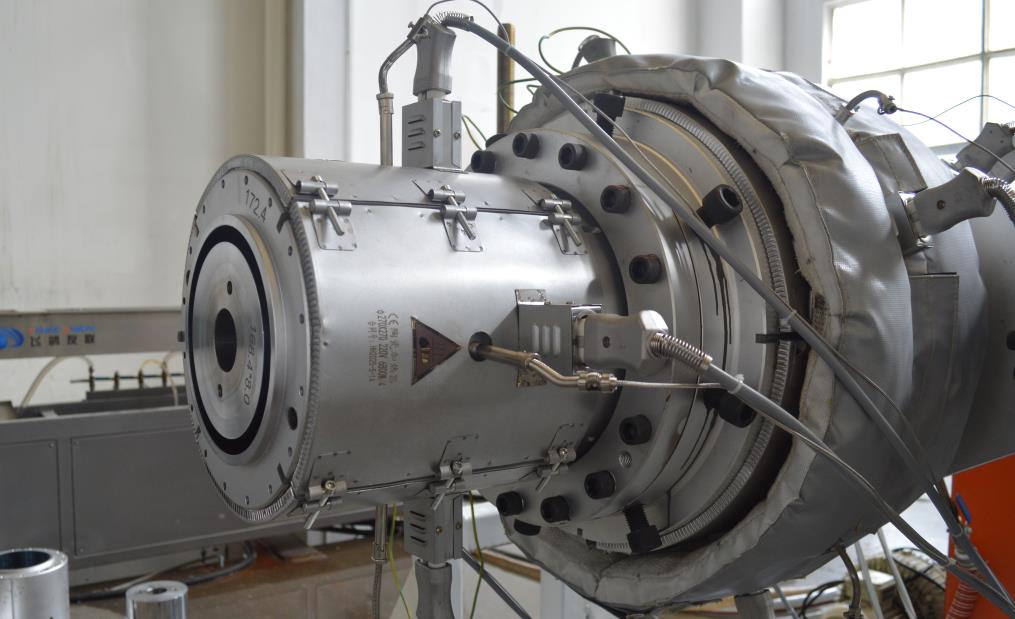
(II) Pipe Surface Defects (Scratches, Pitting, Depressions)
1. Fault Manifestations
Axial or circumferential scratches of varying depths appear on the surface of HDPE pipes; small pits, bubbles or depressions are distributed on the surface, affecting the appearance quality of the pipes, and may reduce the pressure resistance and sealing performance of the pipes in severe cases.
2. Fault Causes
- Impurities, cokes or scratches exist on the surfaces of the die mouth and core die, and the material is scratched during the extrusion process;
- Excessively high die temperature leads to excessive cross-linking or decomposition of the material in the die, generating cokes that adhere to the die surface and transfer to the pipe surface;
- The raw material contains moisture, volatile substances, or the raw material has insufficient purity and mixed impurities. During the extrusion process, moisture evaporation or impurity residue forms pits and depressions;
- Abnormal operation of the die cooling system, excessively high temperature at the die outlet, insufficient cooling of the material, and uneven surface shrinkage forming depressions.
3. Solutions
- Disassemble the die, polish the surfaces of the die mouth and core die with fine sandpaper and polishing paste, remove surface impurities, cokes and scratches, and ensure the smoothness of the die forming surface;
- Adjust the die heating temperature, reduce the temperature of overheated areas to avoid excessive melting or decomposition of the material in the die; at the same time, inspect the temperature control system to ensure accurate temperature display and stable control;
- Pretreat the raw material, dry the HDPE raw material at 80-100℃ for 2-4 hours to remove moisture in the raw material; screen the raw material to remove impurities and ensure the purity of the raw material; avoid mixing different types and melt flow index raw materials;
- Inspect the die cooling system, clean the scale and impurities in the cooling water circuit to ensure smooth circulation of cooling water; adjust the cooling water temperature, reduce the temperature at the die outlet, so that the material can be cooled quickly and evenly after extrusion, avoiding uneven surface shrinkage.
(III) Die Blockage
1. Fault Manifestations
The die discharge volume gradually decreases, or even no discharge at all; the extrusion pressure rises sharply, exceeding the normal working range of the equipment; the equipment has abnormal vibration or noise, and production cannot be carried out normally.
2. Fault Causes
- A large amount of impurities and foreign objects are mixed in the raw material, or the raw material is excessively decomposed in the extruder to generate cokes, which accumulate and block in the die flow channel;
- After long-term use of the die, the surface of the flow channel is worn and rough, and the material is easy to adhere to the flow channel wall and gradually accumulate to form blockage;
- The die temperature setting is too low, the material is not fully melted in the flow channel, has poor fluidity, and is easy to solidify and accumulate to cause blockage;
- The die is not cleaned in time after shutdown, and the residual material cools and solidifies, blocking the flow channel when the machine is started again.
3. Solutions
- Shut down the machine immediately, turn off the die heating system, and after the die temperature drops to a safe range, completely disassemble the die, use special tools (such as copper rods, scrapers) to remove the blockages, accumulated materials and cokes in the flow channel, and soak and clean with solvents (such as trichloroethylene) if necessary to ensure the flow channel is completely unobstructed;
- Polish the worn flow channel surface to restore the smoothness of the flow channel and reduce material adhesion;
- Readjust the die heating temperature to ensure that the temperature meets the processing requirements of the raw material, so that the material is fully melted in the flow channel and maintains good fluidity;
- Establish a standardized shutdown cleaning process, timely clean the residual material in the die after each shutdown to avoid blockage caused by cooling and solidification of the material; at the same time, strengthen the screening of raw materials to avoid mixing impurities.
(IV) Melt Fracture
1. Fault Manifestations
Wavy, sharkskin-like, spiral patterns or irregular bumps appear on the surface of HDPE pipes; in severe cases, the pipes break and deform, and cannot be formed normally. This fault mostly occurs when the material extrusion speed is fast.
2. Fault Causes
- The shear rate of the material at the die outlet is too high, exceeding the critical shear rate of the HDPE raw material, leading to unstable melt flow and fracture;
- Unreasonable design of the die flow channel, sudden changes in the flow channel cross-section, resulting in severe speed changes and shear effects during material flow;
- Excessively low die temperature, high material viscosity, poor fluidity, and increased shear force in the flow channel, which is prone to melt fracture;
- The molecular weight distribution of the raw material is too wide, and the low molecular weight part is prone to flow instability under high shear.
3. Solutions
- Reduce the extrusion speed to reduce the shear rate of the material at the die outlet, making it lower than the critical shear rate of the raw material;
- Optimize the die flow channel design, adopt a gradual flow channel cross-section to avoid sudden changes in cross-section and reduce shear fluctuations during material flow; if the die is finalized and cannot be modified, the fillet radius at the die inlet can be appropriately increased to reduce shear stress;
- Increase the die heating temperature to reduce material viscosity, reduce shear force, and improve melt fluidity;
- Replace HDPE raw materials with narrow molecular weight distribution to ensure stable raw material performance and avoid melt fracture caused by raw material characteristics.
(V) Die Leakage
1. Fault Manifestations
Material leaks from the die’s mating surface, bolt connections or heating coil installation gaps, forming “flash”; in severe cases of leakage, a large amount of material is wasted, and the equipment and production environment are polluted, affecting production safety.
2. Fault Causes
- The mating surface is not cleaned during die assembly, and there are impurities and accumulated materials, leading to poor sealing;
- The die bolts are loose or fatigued and damaged, unable to provide sufficient clamping force, leading to increased gaps on the mating surface;
- The die mating surface is worn and deformed, and the flatness exceeds the tolerance, making effective sealing impossible;
- The extrusion pressure is too high, exceeding the limit pressure that the die seal can bear, leading to material leakage from weak sealing areas.
3. Solutions
- After shutting down the machine, disassemble the die, thoroughly clean the impurities and accumulated materials on the mating surface, and repair the worn and deformed mating surface with a surface grinder to ensure that the flatness of the mating surface meets the requirements;
- Inspect the die bolts, replace fatigued and damaged bolts, and evenly tighten the bolts according to the specified torque to ensure consistent clamping force of each bolt; if necessary, install gaskets on the mating surface to enhance the sealing effect;
- Inspect the extrusion system, adjust the extrusion process parameters (such as reducing the screw speed, adjusting the raw material temperature), and reduce the extrusion pressure to keep it within the range that the die seal can bear;
- Regularly inspect the wear of the die sealing components, timely replace aging and damaged seals, and establish a regular die maintenance system.
II. Preventive Measures for Die Faults
In addition to targeted solutions to existing die faults, taking effective preventive measures can significantly reduce the incidence of faults and improve production efficiency and product quality:
- Raw Material Control: Strictly screen HDPE raw materials to ensure their purity and avoid mixing impurities; pre-dry moisture-absorbing raw materials; unify the batch and type of raw materials to avoid performance fluctuations caused by mixing.
- Daily Die Maintenance: Regularly clean the die flow channel, mouth die and core die to remove accumulated materials and cokes; regularly inspect the die heating system and cooling system to ensure accurate temperature control and smooth cooling circulation; regularly inspect the die bolts, positioning components and seals, and timely fasten or replace damaged components.
- Process Parameter Optimization: According to the raw material characteristics and pipe specifications, reasonably set the die temperature, extrusion speed, extrusion pressure and other process parameters to avoid excessive shear, decomposition or insufficient melting of materials caused by improper parameter settings.
- Die Assembly Accuracy Control: Assemble the die in strict accordance with the operating procedures to ensure the concentricity of the core die and the mouth die, good sealing of the mating surface, and accurate positioning of each component; avoid damage or deformation of die components caused by rough operation.
- Operator Training: Strengthen the technical training of operators to make them familiar with the die structure, working principle and fault diagnosis methods, standardize the operation process, and reduce die faults caused by human error.
III. Conclusion
There are various types of die faults in the HDPE Pipe Extrusion Line, which are mostly related to raw material quality, die structure and maintenance, process parameter settings and other factors. In the actual production process, operators should be familiar with the manifestations and causes of various faults and be able to quickly and accurately take targeted solutions; at the same time, establish a sound die maintenance system and raw material control system, and reduce the incidence of faults through preventive measures to ensure stable and efficient production and improve the quality of HDPE pipe products.